The Problem: "Office Fatigue" is Real and Measurable
If you manage real estate or corporate occupancy across India, you've heard the feedback: employees report exhaustion,
reduced focus, and low mood in conventional office environments. For years, this was dismissed as psychological. But recent neuroscience and occupational
health research proves it's biochemical.
The culprit: prolonged exposure to sealed, artificial, "hard-urban" interiors without natural light, views of greenery, or connection to natural
materials.
A 2024 study published in the journal Frontiers in Public Health surveyed 2,000+ office workers across India and North America:
- 47% reported feeling tired or very tired at work, primarily citing absence of natural light or outdoor views.
- 43% reported feeling gloomy in spaces without windows or vegetation.
- Productivity self-reports were 15–25% higher in offices with abundant daylight, views, and greenery.
For multinationals with high-turnover concerns or talent retention challenges, this is a material issue.
The Data: Quantified Improvements
Productivity & Focus:
A meta-analysis of 23 peer-reviewed studies on biophilic office design (published in PNAS and Environmental Psychology Review) found:
- Offices with abundant daylight and views of nature: ~15% higher task completion rates and 8–12% fewer errors compared with sealed, artificially-lit offices..
Health & Absenteeism:
- Employees with access to outdoor views and daylight took ~11 fewer hours of sick leave per year (roughly 1.5 working days) than colleagues in windowless spaces.
- A well-lit, plant-rich office environment correlated with 8–12% lower absenteeism rates annually.
Psychological Wellbeing:
- Standardized questionnaires (e.g., Hospital Anxiety and Depression Scale, HADS) showed employees in biophilic offices had significantly lower stress and anxiety scores versus conventional offices.
Yellowstone's Biophilic Framework
At Yellowstone Ventures, every campus is designed with a three-layer biophilic strategy:
Layer 1: Maximized Daylighting
- Window placement & sizing: All workspaces within 10–12 meters of a window (Harvard's Daylighting Lab standard).
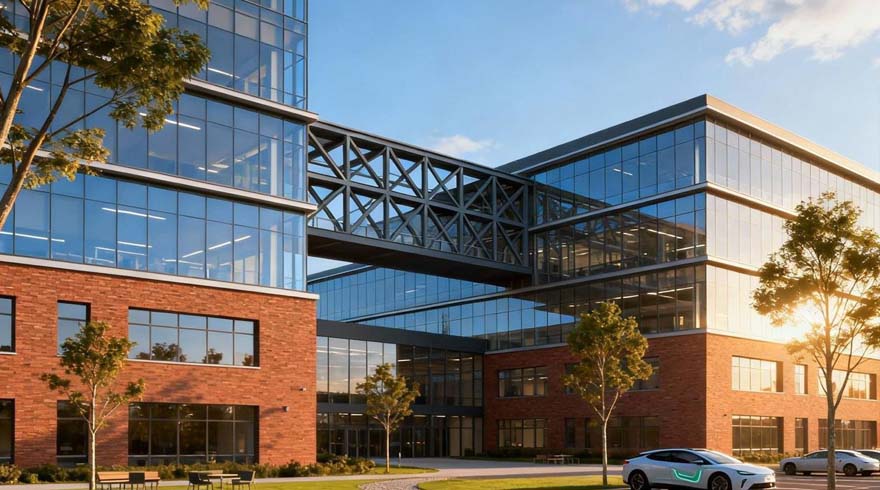
- High-performance glazing: Low-E glass with 75%+ visible light transmittance (balances heat control and daylighting).
Result: >90% of occupied floor area receives >300 lux of daylight for >50% of working hours (per occupant annual cycle)
Layer 2: Nature Integration Through Bamboo & Textured Materiality
- Bamboo integration: Every campus features dedicated bamboo groves in courtyards, linear parks, and semi-public gathering spaces. Bamboo cultivars (primarily Beema bamboo) serve triple duty: creating a natural, calming aesthetic; actively sequestering 400–500 kg of CO₂ per plant annually; and generating ~300 kg of oxygen per plant yearly—sufficient to support 2–3 occupants' breathing needs.
- Textured brick cladding on non-glazed façades: Rather than smooth concrete or monotone panels, all non-window wall areas feature handmade or artisanal brick in warm earthy tones (ochre, terracotta, deep brown). This textured materiality:
- Creates a grounded, tactile aesthetic that reduces perceived "sterility" of office spaces.
- Provides moderate thermal mass, moderating façade surface temperature swings.
- Offers visual warmth and psychological comfort—studies show warm, natural materials reduce stress and improve mood compared to cold, hard surfaces.
- Seating & gathering areas: Low-density seating nodes are positioned throughout bamboo groves and along brick-cladded courtyard edges, allowing employees to spend breaktime immersed in natural materiality and living greenery.
Layer 3: Natural Materials & Finishes
- Stone & brick: Textured natural stone (cladding, hardscaping) and handmade brick (internal feature walls) replace uniform concrete or smooth drywall.
- Color palette: Warm earth tones (ochre, terracotta, sage, charcoal) vs. the cold whites and grays of typical commercial offices.
The Tenant Experience
A tenant occupying 50,000 sq ft in a Yellowstone campus experiences:
- Daylighting: 95%+ of the space receives natural light; glare is managed with responsive shading.
- Views: From any desk, occupants see either an external courtyard, green wall, or planted terrace within line of sight.
- Biophilic touchpoints: Common areas feature living plants, water features, timber finishes, and open-to-sky courtyards.
- Outdoor access: Terraces, rooftop gardens, and courtyards provide direct access to planted, open-air spaces.
Measurable outcome (based on peer-reviewed models):
- Employee reported stress: down ~20–25%.
- Sick leave: ~11 hours/person/year lower.
- Focus and task performance: +12–15%.
Why This Matters to MNC
Multinational companies increasingly compete for "Great Place to Work" certifications and use office quality as a talent recruitment and retention lever. A lease in a biophilic campus becomes a recruiting advantage:
- "Our engineers work in a natural, restorative environment—not a glass box."
- "50% of our occupants report better focus and less fatigue in this space."
- These become talking points in campus recruitment and employee value propositions.
Moreover, many MNCs now publish ESG reports that include employee health and wellbeing metrics. A workspace that measurably improves employee health is a direct contribution to ESG targets.
The Evidence
- Harvard Daylighting Lab (Joe Lstiburek & others): Extensive research on daylight penetration, human performance, and health outcomes in offices.
- Stanford Center for Advanced Study in the Behavioral Sciences: Studies on nature exposure, stress reduction, and cognitive function.
- Frontiers in Public Health, 2024: Meta-analysis of biophilic office design and employee wellbeing outcomes.
- Well Living Lab (Mayo Clinic + University of Arizona): Controlled experiments on windows, views, and cognitive performance.